Discoverable Components


This ADR defines how consumers discover the location of OCI artifacts for different services.
For example, a service provider such as service-provider-crossplane, running inside the OpenControlPlane platform, needs to know where to fetch the Crossplane Helm chart and container image from. This ADR defines the solution.
Terminology
For full background on the Open Component Model, see ocm.software. The entries below cover only what is needed to read this ADR.
- OCM - Open Component Model. Secure delivery for sovereign clouds - deliver and deploy your software securely, anywhere, at any scale. A specification and toolset for describing software components and their resources (images, charts, blobs) in a transport-agnostic way.
- OCM Component - a single, versioned unit described by OCM. It carries a set of
resources(e.g. an OCI image, a Helm chart) and may reference other components viacomponentReferences. - Service OCM Component - an OCM component that represents a single service the platform can install (e.g.
flux,crossplane). It lists all OCM resources that this service needs at a given version (chart, controller images, etc.). - Umbrella OCM Component - an OCM component that contains no resources of its own and only carries
componentReferencesto other OCM components. Used to group a set of service OCM components into one entry point. In this ADR, theReleasechannelis the umbrella OCM component. - Platform cluster - the cluster on which the OpenControlPlane platform runs its
ServiceProvider,PlatformService, andClusterProvidercontrollers. - Consumer - in this ADR, a technical consumer of Discoverable Components. The
ServiceProvider,PlatformService, andClusterProvidercontrollers running on the platform cluster are the consumers: they resolve where to fetch their OCI artifacts from.
Current state
The platform cluster runs three types of controllers, each operating at a different scope - see Plug & Play for a full overview:
- Service Providers add functionality to individual
ControlPlanes(e.g. GitOps tooling, cloud provider APIs). - Platform Services add functionality to the OpenControlPlane environment as a whole (e.g. network services, audit logs).
- Cluster Providers handle the dynamic creation and deletion of Kubernetes clusters behind a homogeneous interface.
Service Providers
Each Service Provider is deployed by creating a ServiceProvider resource in which the OCI image URL of the provider is specified directly:
# From service-provider-flux
apiVersion: openmcp.cloud/v1alpha1
kind: ServiceProvider
metadata:
  name: flux
  namespace: openmcp-system
spec:
  image: ghcr.io/openmcp-project/images/service-provider-flux:v0.1.0
The ProviderConfig resource of a Service Provider defines which versions of the managed service are available. For each version, all OCI artifact URLs (Helm chart and container image) as well as pull secrets for private registries must be specified manually:
# From service-provider-crossplane
apiVersion: crossplane.services.open-control-plane.io/v1alpha1
kind: ProviderConfig
metadata:
  name: default
spec:
  versions:
    - version: v2.0.2
      chart:
        url: "ghcr.io/openmcp-project/openmcp/charts/crossplane:2.0.2"
        secretRef:
          name: ghcr
      image:
        url: "ghcr.io/openmcp-project/openmcp/images/crossplane:2.0.2"
        secretRef:
          name: xyz
    - version: v1.20.0
      chart:
        url: "ghcr.io/openmcp-project/openmcp/charts/crossplane:1.20.0"
        secretRef:
          name: ghcr
      image:
        url: "ghcr.io/openmcp-project/openmcp/images/crossplane:1.20.0"
        secretRef:
          name: xyz
  providers:
    availableProviders:
      - name: provider-kubernetes
        package: xpkg.upbound.io/upbound/provider-kubernetes
        versions:
          - v0.16.0
          - v0.15.0
    imagePullSecretRefs:
      - name: secretforprivateproviders
# From service-provider-flux
apiVersion: flux.services.open-control-plane.io/v1alpha1
kind: ProviderConfig
metadata:
  name: flux
spec:
  versions:
    - version: "2.8.3"
      chartVersion: "2.18.2"
      chartUrl: "oci://ghcr.io/fluxcd-community/charts/flux2"
      chartPullSecret: "chart-registry-credentials"
      values:
        imagePullSecrets:
          - name: "image-registry-credentials"
        helmController:
          image: my-registry.example.com/fluxcd/helm-controller
          tag: v1.5.3
        sourceController:
          image: my-registry.example.com/fluxcd/source-controller
          tag: v1.8.1
Platform Services
When installing a Platform Service, the OCI image URL of the controller is specified directly in the PlatformService resource:
# From platform-service-gateway
apiVersion: openmcp.cloud/v1alpha1
kind: PlatformService
metadata:
  name: gateway
spec:
  image: ghcr.io/openmcp-project/images/platform-service-gateway:v0.1.0
A Platform Service may additionally expose a service-specific configuration resource in which image URLs and Helm chart locations for its dependencies must be configured manually:
# From platform-service-gateway - GatewayServiceConfig
apiVersion: gateway.openmcp.cloud/v1alpha1
kind: GatewayServiceConfig
metadata:
  name: gateway
spec:
  envoyGateway:
    images:
      proxy: "ghcr.io/openmcp-project/components/github.com/openmcp-project/openmcp/images/envoy-proxy:distroless-v1.36.2"
      gateway: "ghcr.io/openmcp-project/components/github.com/openmcp-project/openmcp/images/envoy-gateway:v1.5.4"
      rateLimit: "ghcr.io/openmcp-project/components/github.com/openmcp-project/openmcp/images/envoy-ratelimit:99d85510"
    chart:
      url: "oci://ghcr.io/openmcp-project/components/github.com/openmcp-project/openmcp/charts/envoy-gateway"
      tag: "1.5.4"
  clusters:
    - selector:
        matchPurpose: platform
    - selector:
        matchPurpose: workload
  dns:
    baseDomain: dev.openmcp.example.com
Cluster Providers
When installing a Cluster Provider, the OCI image URL is specified directly in the ClusterProvider resource:
# From cluster-provider-gardener
apiVersion: openmcp.cloud/v1alpha1
kind: ClusterProvider
metadata:
  name: gardener
spec:
  image: "ghcr.io/openmcp-project/images/cluster-provider-gardener:v0.2.0"
Requirements
A centrally managed, platform-provided mechanism for resolving the location of OCI images must satisfy the following.
- Multiple versions of an artifact must be storable.
- The solution must support local development.
- Pull secrets for an artifact must be discoverable alongside the artifact itself, not configured separately by every consumer. In OCM, the controllers propagate a parent component's secret reference down to every child resource automatically, so each resolved resource carries its own pull-secret reference. For the Artifacts API the same concept applies, but expressed in-cluster: the
Artifactresource carries its pull-secret references directly inspec.pullsecrets, populated by the translation layer when it materialises the OCM content.
Flows That Must Be Supported
- Retrieve all versions of an artifact, e.g.
crossplane-chart. - Retrieve the pull secrets for artifact
crossplane-chartat versionv1.10. - Different versions of an artifact may originate from different registries.
Scope
This ADR covers platform-internal artifact discovery only. It is sufficient on its own for ServiceProvider, PlatformService, and ClusterProvider to resolve where to fetch their OCI artifacts from. The user-facing API for selecting a service version is decided in a follow-up ADR and is not required to implement what is proposed here.
In Scope
- OCI images and artifacts only.
- How
ServiceProvider,PlatformService, andClusterProviderdiscover what artifacts are available and where to fetch them from. - Defining the structure of the
ReleasechannelOCM component.
Out of Scope
- The user-facing API for selecting a service version (e.g. how an end user requests "Flux v2.2.0"). To be discussed in a follow-up ADR.
- How a
Releasechannelis built, signed, or published. Only its structure is defined here. - Lifecycle and rollout of
Releasechannelversions.
Releasechannel OCM Component
A single umbrella OCM component, Releasechannel, acts as the entry point for all artifacts the platform knows about. The cluster is configured with one piece of information - the Releasechannel version to consume - and discovers everything else from its content. In practice this is expressed as an OCM Component resource managed by the OCM controllers, pointing at the published Releasechannel and pinning its version.
Structure
Releasechannel is a pure pointer component. It contains no resources of its own; it only carries componentReferences to per-service OCM components.
Each componentReference is a direct (name, version) reference to another OCM component. There is no grouping layer in between, so multiple versions of the same service appear as separate entries:
Releasechannel v1.8.9
├── componentReference: flux       v2.2.0
├── componentReference: flux       v2.1.0
├── componentReference: crossplane v2.0.0
└── …
Each per-service OCM component lists its OCM resources - for example, the flux component at v2.2.0 carries:
- helm chart
- helm-controller image
- kustomize-controller image
- source-controller image
- notification-controller image
- …
A consumer that picks "flux at version v2.2.0" resolves through the matching componentReference into the concrete set of resources (chart + controller images) that this version of flux ships.
Why this structure
The customer installs a service component version, not individual resource versions. Saying "install flux v2.2.0" must be enough for the platform to know which chart and which controller images to pull. OCM performs that resolution natively once the components are structured this way; the platform does not need its own version-mapping layer.
Listing each version as its own componentReference also makes "which versions of flux are available?" answerable by enumerating the references of the current Releasechannel.
Why OCM
The choice of OCM as the underlying mechanism is deliberate. OCM gives the platform two properties that are hard to get otherwise:
- Localization / transport. A whole
Releasechannel, including every referenced service OCM component and every resource (chart, image) it transitively pulls in, can be transported to a different OCI registry as a single unit using OCM tooling. Consumers then point at the new registry and continue to operate without any other change. - Air-gapped deployments. The same property makes air-gapped environments approachable: mirror the
Releasechannelonce, and all artifacts the platform needs are reachable inside the isolated network.
Building a comparable mechanism on top of plain OCI references would mean re-implementing transport, signing, and integrity checks that OCM already provides.
These same properties are the reason the whole OpenControlPlane platform is itself bundled and released as one umbrella OCM component - see openmcp-project/openmcp. Using OCM for the Releasechannel keeps the discovery layer aligned with how the platform itself is delivered.
Scope of consumers
Although the ADR is motivated by ServiceProvider resolving service artifacts, the concept is intentionally open: any part of the platform that needs to know where an OCI artifact lives can infer it from the same Releasechannel. In particular, the install image of a PlatformService or a ClusterProvider can be discovered the same way as a service's chart or controller image. The Releasechannel is the single source of truth for "what is installable, in which versions, and where to fetch it from".
Hosting
In production, a Releasechannel is published to an OCI registry. The cluster only needs to know the registry URL and Releasechannel version; everything else is discovered in-cluster from the resolved component graph.
For local development, KIND (Kubernetes IN Docker) based e2e, or quick try-out scenarios, requiring an OCI registry to host a Releasechannel is a hard external dependency. The two approaches below address this differently.
Proposal
The Releasechannel defined above is the single source of truth for what is installable, in which versions, and where to fetch it from. This is common to both approaches below; they differ only in how consumers read from the Releasechannel:
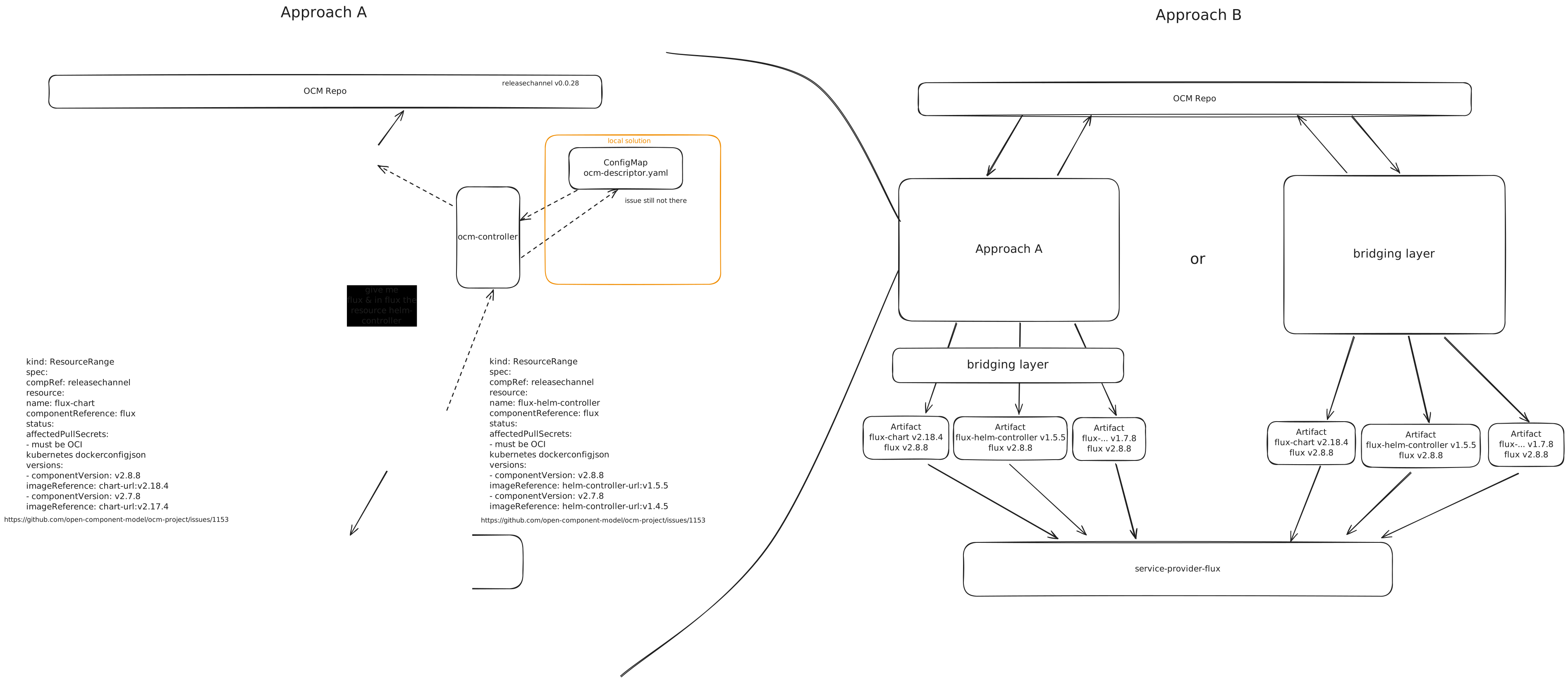
- Approach A - Direct OCM consumption. Consumers query the
Releasechannelthrough OCM controllers. Requires upstream OCM controller features that do not exist yet. - Approach B - Artifacts API translation layer. The platform translates the resolved OCM content into
ArtifactKubernetes resources. Consumers read those instead of OCM directly. Optional addition, independent of the upstream OCM roadmap.
Approach A - Direct OCM consumption
Consumers (ServiceProvider, PlatformService, ClusterProvider) read the Releasechannel through OCM controllers directly. No intermediate Kubernetes API on the platform side.
Required OCM controller capabilities
This approach depends on two capabilities of the upstream OCM controllers that do not exist in their current form:
- Discovery from an umbrella component. Today, OCM controllers require both the component name and the resource name to be specified explicitly (1:1 lookup). Approach A needs the controllers to enumerate
componentReferencesof aReleasechanneland, per service component, enumerate the available resources in-cluster. Tracked upstream in open-component-model/ocm-project#1153 ("Make components and resources discoverable through ocm-k8s-toolkit"). - Local-YAML fallback for offline scenarios. A way to back the lookup with a plain YAML file pointing at upstream registries, so that local development and e2e tests do not require an OCI registry hosting a full
Releasechannel. Discussed with OCM maintainers; no public issue yet.
Approach B - Artifacts API translation layer
An optional addition on top of Approach A. The platform introduces a new Kubernetes API that materialises the resolved content of the Releasechannel as in-cluster resources. Consumers read those resources instead of querying OCM directly.
The Releasechannel remains the source of truth in production: a translation layer reads it via OCM and creates the corresponding Artifact resources. In local or e2e setups, Artifact resources can be applied directly without an OCI registry, removing the dependency on the upstream OCM features listed in Approach A.
Artifacts
A new resource on the platform cluster called Artifact. Each Artifact points to exactly one OCI image. The CRD is cluster-scoped. Because Artifacts live on the platform cluster, they are not reachable by end customers.
Artifact resources are created in one of two ways, depending on environment:
- Local / e2e.
Artifacts are applied manually to the (KIND) cluster. No OCM registry or translation layer is involved. - Production. A translation layer materialises
Artifacts from the resolved OCM components on a configurable interval. On each reconcile it overwrites any local edits, keeping theReleasechannelthe single source of truth.
Two version concepts appear in the examples below and must not be confused:
componentVersionis the version of the OCM service component the user selects, e.g.flux v2.8.8. This is what anArtifact'sspec.versioncarries. Picking acomponentVersionresolves into a fixed set ofArtifactresources.artifactVersionis the tag of the underlying OCI image, or in OCM terms the resource version. It is what ends up in the artifact'surl(e.g.:v1.5.5for the flux helm-controller image while the chart is at:v2.18.4).
A single componentVersion therefore typically pins multiple, independent artifactVersions. Consumers select by componentVersion; the corresponding artifactVersions come along automatically.
kind: Artifact
metadata:
  name: flux-chart-v2.8.8
spec:
  name: flux-chart
  version: v2.8.8
  url: example-reg.io/charts/flux:v2.18.4@sha256:23426aabcd...
  pullsecrets:                      # if from authenticated registry
    - name: registry-pull-secret    # required. `Artifact` is cluster-scoped, so namespace is mandatory.
      namespace: openmcp-system
The metadata.name of an Artifact is arbitrary. As a best practice, use <artifact-name>-<componentVersion> (e.g. flux-chart-v2.8.8) for readability.
Artifacts are intended to be retrieved by their spec fields using a fieldSelector.
For this to work, the Artifact CRD must declare spec.name and spec.version in spec.versions[*].selectableFields (see CRD selectable fields).
The spec.version field on an Artifact is the componentVersion, not the OCI tag of the underlying image. The OCI tag (the artifactVersion) is encoded in spec.url.
For example, flux at componentVersion v2.8.8 is a component that consists of one chart and multiple controller images at independent artifactVersions. The resulting Artifact resources are:
kind: Artifact
metadata:
  name: flux-chart-v2.8.8
spec:
  name: flux-chart
  version: v2.8.8
  url: example-reg.io/charts/flux:v2.18.4@sha256:23426aabcd...
  pullsecrets:                      # if from authenticated registry
    - name: registry-pull-secret
      namespace: openmcp-system
---
kind: Artifact
metadata:
  name: flux-helm-controller-v2.8.8
spec:
  name: flux-helm-controller
  version: v2.8.8
  url: ghcr.io/fluxcd/helm-controller:v1.5.5@sha256:23426aabcd...
  pullsecrets:                      # if from authenticated registry
    - name: registry-pull-secret
      namespace: openmcp-system
---
kind: Artifact
metadata:
  name: flux-kustomize-controller-v2.8.8
spec:
  name: flux-kustomize-controller
  version: v2.8.8
  url: ghcr.io/fluxcd/kustomize-controller:v1.8.5@sha256:23426aabcd...
  pullsecrets:                      # if from authenticated registry
    - name: registry-pull-secret
      namespace: openmcp-system
---
kind: Artifact
metadata:
  name: flux-source-controller-v2.8.8
spec:
  name: flux-source-controller
  version: v2.8.8
  url: ghcr.io/fluxcd/source-controller:v1.8.5@sha256:23426aabcd...
  pullsecrets:                      # if from authenticated registry
    - name: registry-pull-secret
      namespace: openmcp-system
# ... additional controller Artifacts (image-automation, image-reflector, notification, ...) follow the same shape.
All Artifact resources share the same componentVersion v2.8.8 while carrying independent artifactVersions in their url. A consuming entity can therefore resolve: "for component version v2.8.8, pull chart tag v2.18.4, helm-controller tag v1.5.5, kustomize-controller tag v1.8.5, source-controller tag v1.8.5, ..."
ProviderConfig Example
Every ServiceProvider has a ProviderConfig resource. To inform the ServiceProvider how to locate the relevant Artifact resources, selectors are defined in the ProviderConfig.
Multiple componentVersions of the same service coexist as independent Artifact sets on the platform cluster. A single ProviderConfig selects across all of them via fieldSelector on spec.name; the end user then picks the concrete componentVersion per ControlPlane (out of scope for this ADR).
Example: crossplane at componentVersion v1.20.1 and v2.0.2. Both versions ship a matching chart and image artifactVersion, so eight Artifact resources exist on the platform cluster:
kind: Artifact
metadata:
  name: crossplane-chart-v1.20.1
spec:
  name: crossplane-chart
  version: v1.20.1
  url: example-reg.io/charts/crossplane:v1.20.1@sha256:23426aabcd...
---
kind: Artifact
metadata:
  name: crossplane-image-v1.20.1
spec:
  name: crossplane-image
  version: v1.20.1
  url: xpkg.crossplane.io/crossplane/crossplane:v1.20.1@sha256:23426aabcd...
---
kind: Artifact
metadata:
  name: crossplane-chart-v2.0.2
spec:
  name: crossplane-chart
  version: v2.0.2
  url: example-reg.io/charts/crossplane:v2.0.2@sha256:23426aabcd...
---
kind: Artifact
metadata:
  name: crossplane-image-v2.0.2
spec:
  name: crossplane-image
  version: v2.0.2
  url: xpkg.crossplane.io/crossplane/crossplane:v2.0.2@sha256:23426aabcd...
A single ProviderConfig selects both versions by matching on spec.name only:
apiVersion: crossplane.services.open-control-plane.io/v1alpha1
kind: ProviderConfig
spec:
  chart:
    selectors:
      matchFields:
        - artifactName: crossplane-chart
  image:
    selectors:
      matchFields:
        - artifactName: crossplane-image
  providers:
    selectors:
      matchLabels:
        crossplane.services.open-control-plane.io/type: "provider"
  functions:
    selectors:
      matchLabels:
        crossplane.services.open-control-plane.io/type: "functions"
Each selector resolves to multiple Artifact resources (one per componentVersion). The consumer picks the concrete spec.version per ControlPlane at request time.
Pros and Cons
Both approaches share the Releasechannel OCM component as the source of truth. The trade-off is purely in the consumption path.
Approach A - Direct OCM consumption
Pros
- Single source of truth, single read path: consumers resolve the
Releasechanneldirectly via OCM. - No additional CRD or controller logic to maintain on the platform side.
- Lowest overall complexity once the upstream OCM features are in place.
Cons
- Blocked on upstream OCM controller features that do not yet exist (umbrella-component discovery, see open-component-model/ocm-project#1153 "Make components and resources discoverable through ocm-k8s-toolkit"; local-YAML fallback for offline use).
- Local development, KIND-based e2e, and try-out scenarios are only viable once the local-YAML fallback exists upstream.
- Platform's delivery timeline is coupled to the OCM upstream roadmap.
Approach B - Artifacts API translation layer
Pros
- Decouples the platform from the upstream OCM roadmap: ships independently of open-component-model/ocm-project#1153 ("Make components and resources discoverable through ocm-k8s-toolkit") and the local-YAML fallback.
- Local development and e2e tests work by applying
Artifactresources directly into a KIND cluster - no OCI registry, no OCM controller features required. - Consumers see a plain Kubernetes API with selectors, familiar to anyone working with CRDs.
Cons
- Adds a CRD that the platform must own and maintain on top of the OCM-based source of truth.
- Requires a translation layer from resolved OCM components to
Artifactresources, which is additional code to write, test, and operate. - Increases overall complexity: the platform maintains both the API and the OCM-to-Artifact bridge instead of relying on OCM end-to-end.
- Two representations of the same data in production raise the surface for drift and bugs.
Decision
The team decided on Approach A - Direct OCM consumption.
Consumers (ServiceProvider, PlatformService, ClusterProvider) resolve the Releasechannel directly via OCM controllers, with no intermediate Kubernetes API on the platform side. This keeps a single source of truth and a single read path, avoids maintaining an additional CRD and translation layer, and keeps the discovery layer aligned with how the platform itself is delivered as an umbrella OCM component.
This choice depends on the upstream OCM controller capabilities described above - umbrella-component discovery (tracked in open-component-model/ocm-project#1153) and the local-YAML fallback for offline scenarios.